

Welcome back to “One First,” a newsletter that aims to make the U.S. Supreme Court more accessible to lawyers and non-lawyers alike. I’m grateful to all of you for your continued support, and I hope that you’ll consider sharing some of what we’re doing with your networks.
If you’re not already a subscriber, please consider becoming one—and upgrading to a paid subscription if and when your circumstances permit:
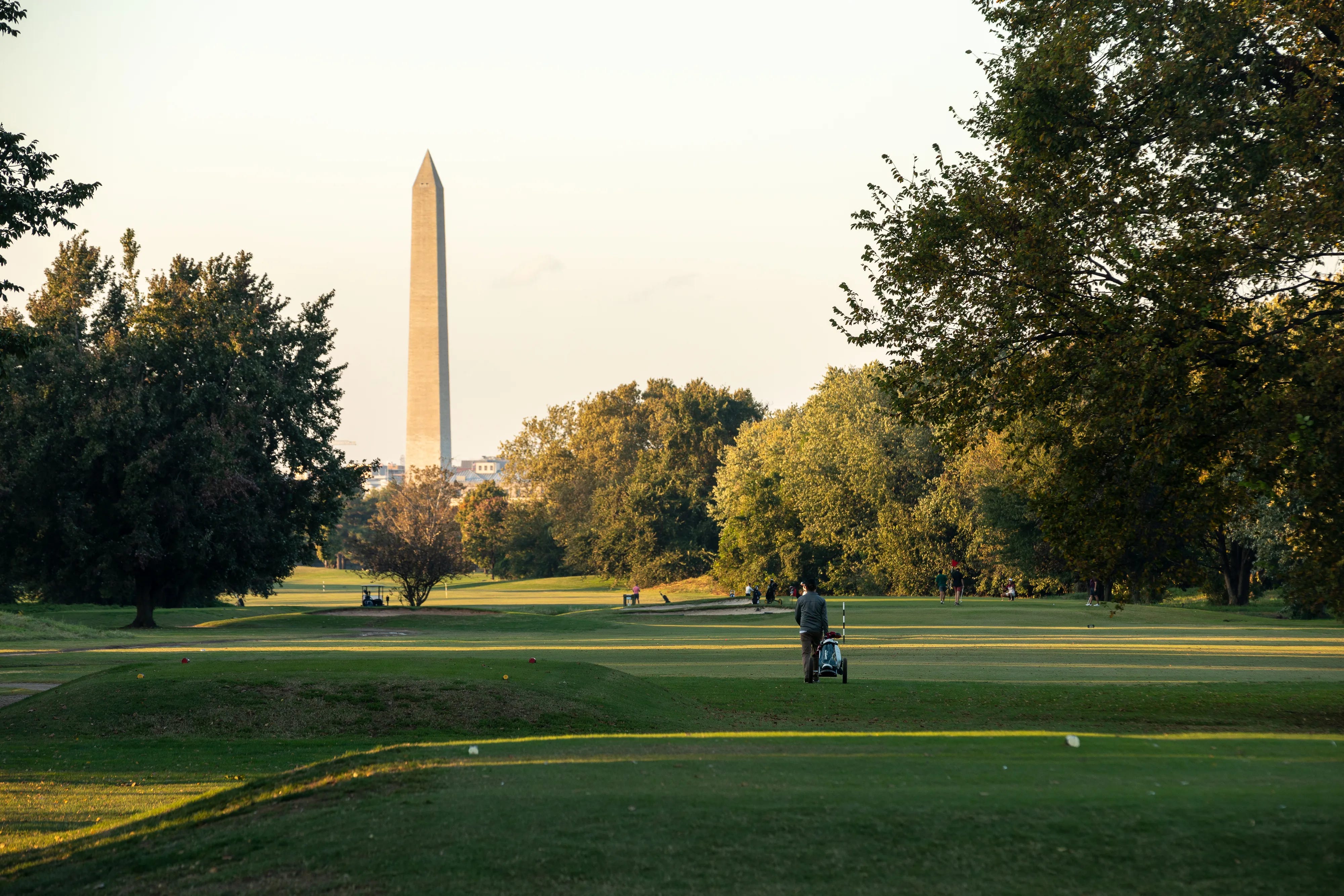
Chances are, you haven’t been following every jot and tittle in the litigation over the Trump administration’s plan to renovate the East Potomac Golf Links—a century-old, low-cost public golf course on a man-made island just south of the west end of the Mall in Washington, D.C. But for as inconsequential as that lawsuit may seem compared to challenges to nationwide immigration policies or disputes over efforts to interfere in the upcoming midterm elections, the case has become a flashpoint for the Department of Justice’s increasingly insolent behavior toward federal district judges—especially when those judges have had the temerity to express frustration and exasperation over the government’s non-compliance with their prior court orders.
There are certainly lines that judges can cross in their behavior toward parties. But notwithstanding the pearl-clutching by the government itself (to say nothing of right-wing social media), a full assessment of the record in the East Potomac case sure seems to suggest that the problematic behavior has come from the government, and not from Judge Ana Reyes. The real-world stakes of the East Potomac case may be modest—especially compared to everything else that’s going on. But the institutional stakes are substantial—and they’re growing by the day.
More on that below. But first, the (Supreme Court) news.
On the Docket
The Merits Docket
Besides the second week of the October argument session, the big news on the merits docket last week involved the grants of certiorari in three additional cases—the biggest of which involves how much information courts can require the government to disclose in FOIA litigation about the internal structure and operations of the “U.S. DOGE Service.” (The Court has previously intervened in this case on the emergency docket, albeit in a way that left that question open.) The three grants bring the total number of “merits” cases on the Court’s OT2026 docket to 32 (two of which are consolidated, so really 31), which means the justices are just over halfway toward filling out their docket for the current term.
Justice Sotomayor also filed a “statement” respecting the denial of certiorari in Herrera-Salazar v. United States—about a serious double jeopardy problem with how the government charged a non-citizen with being “found in” the United States after his removal. Justice Gorsuch joined the statement. (It’s often a good bet, when Sotomayor and Gorsuch are on the same side, that they’re right.)
The Emergency Docket
As usual, the biggest news from the Court came on the emergency docket—to wit, Wednesday’s grant of a stay in FCC v. Brown, the dispute over the “Lowest Unit Charge” rule that I described in detail in last Monday’s newsletter. Once again, the majority provided an “opinion of the Court” respecting a grant of emergency relief.1 This time, the stated rationale was that it wasn’t appropriate for the Fourth Circuit to order the FCC to act by a date certain because the Communications Act “does not obligate the Commission to act within a particular timeframe.” That’s certainly true, but it does nothing to address the challengers’ claim (and the Fourth Circuit’s concern) that the FCC is deliberately stalling its review process for the purpose of thwarting pre-election judicial review—which may explain why Justices Sotomayor and Jackson dissented, albeit without opinion.
As I suggested last week, it’s more than a little difficult to imagine that the justices in the majority would be quite so circumspect about the courts’ authority to compel agency action if they were more troubled by the consequences of the administrative delay. But at least the majority, unlike the Wall Street Journal editorial board, declined to endorse the government’s rather brazen misportrayal of the Fourth Circuit’s behavior in this case.
The other full Court ruling on an emergency application came on Monday, when the justices denied—over no public dissents—Kyle Wagner’s application effectively seeking to reinstate the district court’s pre-trial release order (which I also covered last week).
Beyond those two rulings, the other big news on the emergency docket last week was the absence of news on two other major applications that have now been fully briefed—the Trump administration’s application in the transgender prisoner medical care case and the Alliance Defending Freedom’s application on behalf of a female Washington state public high school wrestler seeking to be exempted from having to compete against transgender women. Especially in the prisoner case (which has been fully briefed since October 9), that sure seems to suggest that a dissent is forthcoming (from the usual suspects, if I had to guess).
There are also two new applications by states that are likely to get attention from the full Court. The first, by Louisiana, is a bit of a civil procedure bonanza. In a nutshell, Louisiana sued an energy company in Louisiana state court. The energy company removed the case to federal court, but Louisiana succeeded on a motion to “remand” the case back to state court (on the ground that removal was improper). The energy company appealed that ruling to the Fifth Circuit, which treated the appeal as necessarily freezing state-court proceedings for the duration of the energy company’s appeal. Louisiana is asking the justices to let those proceedings continue (and, in the alternative, to jump over the Fifth Circuit and grant “certiorari before judgment” to quickly resolve who’s right about the effects of the federal appeal on the state-court litigation, a matter that has apparently divided the federal courts of appeals).
Among lots of other things, this case is a good example of the “normalization” of the emergency docket (and the broader “Court of first view” phenomenon); a decade ago, no one would have thought to even ask the justices to intervene in this kind of procedural dispute—either on the emergency docket or by granting certiorari before judgment. Here, we get requests for both. And even though the case comes from the Fifth Circuit, it’s Justice Sotomayor who has ordered the energy company to respond—by 4 p.m. (ET) on Wednesday. Presumably, that’s because Justice Alito is (once again) recused.
The other new application of note is New Hampshire’s application in an election-related voter ID dispute. In a nutshell, the New Hampshire legislature passed a law barring the use of student IDs as affirmative proof of identity for purposes of voter registration or obtaining or casting a ballot. But New Hampshire law also has a safety-valve provision that allows voters without an approved, government-issued ID to establish their identity through other reasonably reliable means. New Hampshire’s Secretary of State issued guidance that student IDs couldn’t be used to satisfy that provision, either, guidance a district court enjoined on both First and Twenty-Sixth(!) Amendment grounds. A divided First Circuit denied a stay pending appeal, and New Hampshire is asking the justices for a Purcell stay—arguing that the district court’s intervention is too close to the election. Justice Jackson has called for a response by 11 a.m. (ET) today, so this one is likely to move quickly. And in case the partisan valence of this dispute wasn’t already clear, New Hampshire’s application already has the support of an amicus brief from the Republican National Committee.
The Week Ahead
We expect a regular Order List from the justices at 9:30 a.m. (ET) today—for grants and denials out of last Friday’s Conference. John Elwood’s Relist Watch offers some good candidates for grants; I’ll be looking to see if the Court denies certiorari in the two pending petitions from defendants in the 9/11 military commission proceedings at Guantánamo challenging then-Secretary of Defense Lloyd Austin’s rescission of their plea agreements. (I filed an amicus brief in support of review in one of the cases.)
The justices aren’t set to take the bench this week, or even to meet in person for a Conference. So after the Order List, the only news we’re likely to get from the Court will be, as usual, from the emergency docket.
Miscellaneous
Finally, I’m going to try to get back into the habit of sharing my own public Supreme Court-related appearances. To that end, I’ve got two events to flag this week: On Thursday, I’ll be speaking at 10:30 a.m. at the American Constitution Society’s D.C. symposium on “1983 in 2026: Federal and State Developments in Law Enforcement Accountability.” Our panel, with Professors Kami N. Chavis and Danielle C. Jefferis (and moderated by Akua Amaning), will explore “The Rise and Fall of Bivens,” with a special eye toward the upcoming Supreme Court argument in Nielsen v. Watanabe.
And on Friday, I’ll be in New Haven for the Yale Law School Media Freedom and Information Access Clinic’s annual conference on “Access and Accountability.” Following a conversation between Professor Bill Eskridge and Justice Breyer, I’ll be on a panel with Michael Dreeben, Linda Greenhouse, and Ilya Shapiro about “Accountability and the Courts,” moderated by Professor Robert Post. (For those who are wondering whether I’m a Sally’s or Pepe’s person, the correct answer is “Antonio’s.”)
The One First “Long Read”: The Government’s Behavior in the East Potomac Litigation
At bottom, the East Potomac Golf Links litigation is about whether the federal government can turn a century-old, low-cost public golf course into a championship venue tied to the President without first conducting the environmental and historic-preservation reviews that federal law requires. The tree removal is where that fight has come to a head. The government’s central argument is that it is restoring the course’s original 1920s look. The plaintiffs have argued that, as has been true in the litigation over the East Wing of the White House, the tree removal is an early, irreversible step in a redesign that has never been reviewed—and that the time to litigate whether those reviews are required is when they could still make a difference, i.e., before that removal takes place.2
By way of background, East Potomac Park is on a man-made island just south of the National Mall. Congress set it aside in 1897 as “a park for the recreation and pleasure of the people.” Its golf course opened in 1920 and is widely seen as a model for affordable public golf—used heavily by juniors and beginners.
As relevant to the current litigation, in 2020, the National Park Service leased the course, along with two others, to the National Links Trust. The Trust is a nonprofit that planned to restore the courses over a 50-year term. Under its management, annual rounds at East Potomac roughly doubled, from fewer than 60,000 to more than 120,000.
In August 2025, Interior Secretary Doug Burgum apparently pitched President Trump on rebuilding East Potomac as a high-end tournament venue called “Washington National Golf Course,” and the President quickly warmed to the idea. That October, about 30,000 cubic yards of debris from the White House East Wing excavation were dumped on the course. In late December, Interior terminated the Trust’s lease, saying it had failed to make required improvements and pay rent. (The Trust has disputed this claim, pointing to more than $8.5 million in capital investment. What’s more, the lease’s renovation timetable was expressly “general and subject to change.”)
In February 2026, the D.C. Preservation League and two regular golfers, Alex Dickson and Dave Roberts, sued the Department of the Interior, the Park Service, Secretary Burgum, and acting Park Service Director Jessica Bowron in the D.C. federal district court. The basic claim is that the government adopted and is carrying out the “Washington National” plan without the reviews required by the National Environmental Policy Act; the National Historic Preservation Act; and the National Park Service Organic Act. They also contend that the plan defeats the 1897 statute’s purpose of a park for public recreation. On the environmental side, they allege that the East Wing debris (which may well contain asbestos and other harmful toxins and other chemicals) was dumped on the course without the required review. They’ve also consistently accused the government of “segmentation,” i.e., an attempt to carry out a large project in small pieces to frustrate comprehensive judicial review.
Critically, Judge Ana Reyes initially deferred the plaintiffs’ request for preliminary relief entirely because of the government’s representations “that no plans have been approved on the East Potomac Golf Course or are scheduled to take place,” apart from the land filling. In a subsequent filing, an NPS official said that renovation plans “remain in the conceptual stage.” Instead, Reyes directed the parties to agree that the government would notify the court and plaintiffs before any major work began. As she explained, “[t]he only reason I’m not making an injunction order is because I don’t want to put people through contempt proceedings. I want to trust that people are acting in good faith . . . until proven otherwise, and you have not proven otherwise to me in this litigation.”
In other words, while receiving briefing and developing the record on the plaintiffs’ substantive claims, the only specific demand Reyes imposed on the government was to provide notice before any especially significant maintenance work on the course was undertaken (including the removal of more than 10 trees)—so that she could then decide if more coercive relief was appropriate before the work was performed. And as I hope this summary makes clear, there was no ambiguity about any of this. Indeed, my count of the record as of the beginning of this month identifies more than ten different instances over the course of the litigation in which the plaintiffs asked Judge Reyes for some kind of interim relief—and she denied all of them.
That’s where things stood two weeks ago, when the Department of the Interior apparently decided to fully consider and approve the tree removal plan in just five days—from October 5 to 9 (a bit ironic given the timeline the Supreme Court thought the Fourth Circuit couldn’t impose on the FCC). It notified the plaintiffs only at 4:55 p.m. on the Friday before the holiday weekend, and crews appear to have cut down about 430 trees the next day.
To be clear, the government has non-frivolous substantive arguments for why it has the authority to renovate the East Potomac course. Its stated reason for removing the trees is historic restoration tied to a 2019 “Cultural Landscape Report.” That report found that a century of tree planting had obscured views and changed the course from its original “links-style” design, which has few trees and open sightlines. National Mall Superintendent Kevin Griess swore in a declaration that the agency intends to stay true to that links character. He wrote that up to 529 trees that “do not contribute to the historic landscape” would be removed. He added that no healthy trees that are historic features, such as the cherry trees, would be chopped down.
The problem here is two-fold. First, the developing record in the district court has … complicated … that account. A Park Service deputy director testified that the project was in fact part of the President’s March 2025 executive order to make D.C. safer and more beautiful, not a reaction to the 2019 report. That official and another one also acknowledged there was no urgent deadline requiring immediate action. As Judge Reyes concluded, the government rushed “because President Trump demands haste on his redesign,” not out of “some newfound zeal” to carry out the 2019 report. All of that may well matter when it comes to the merits of the plaintiffs’ claims.
Second, and in any event, the government was under an obligation to provide meaningful notice to the plaintiffs and Judge Reyes before any meaningful work was undertaken to implement the plan. And the purpose of that notice was to provide the parties and the court with time to resolve whether implementation of the plan should be blocked pending its judicial review. In other words, the notice requirement wasn’t to let the court know the work was underway; it was to give the court time to decide if the work should be allowed to proceed. Suffice it to say, belatedly apprising the plaintiffs and the court five minutes before the close of business at the beginning of a holiday weekend that you’re imminently going to do something you said you’d warn them about in advance is inconsistent with that obligation.
All of this led to the drama that has since received media attention. Reyes held an extraordinary four-hour hearing on Indigenous Peoples’ Day, and issued a temporary restraining order (that she has since extended) barring the removal of any more trees. In last Monday’s hearing, Reyes told the government’s lawyers that they had “lost credibility” through their behavior, and was heated in her questioning not just of the Justice Department’s representatives, but of the government witnesses during the hearing (one of whom participated via a cell phone from his car). Another hearing, with witnesses who weren’t available last Monday, is set for later today.
And yet, instead of appealing Judge Reyes’s TRO (a maneuver it has not been shy about pursuing in other cases despite the traditional unappealability of TROs), the Department of Justice moved on Friday to disqualify Reyes from the case. DOJ’s motion is extraordinary in several respects (the least significant of which is its misrepresentations of the plaintiffs’ position). Among other things, it accuses Judge Reyes of “histrionics”; it asserts that she prejudged motions not yet filed and wrongly summoned witnesses with no notice on a federal holiday (one of whom, it should be noted, was one of the government’s principal declarants in the same case);3 it argues that her May ruling “effectively granted Plaintiffs veto power” over park maintenance (which is an odd thing to complain about in seeking disqualification in October); and it more broadly claims a “pattern of animus” against the Trump administration going back to Judge Reyes’s rulings in a 2025 case about transgender servicemembers (never mind Reyes’s repeated refusals to intervene in this case before last week, all of which are inconsistent with such a pattern).
In essence, the government’s motion to disqualify Judge Reyes asks her to answer for the consequences of its conduct. For months, Reyes gave the administration the benefit of the doubt. She declined to enter an injunction because she wanted “to trust that people are acting in good faith,” and she relied on repeated assurances that no plans had been approved for the course. The government then approved a tree-removal plan within five days, and it told the court only at 4:55 p.m. on the Friday before a holiday weekend—only to now complain that Judge Reyes dared to call witnesses to an emergency hearing on that very federal holiday.
Nothing about the future of the Republic turns on whether East Potomac becomes a championship course or continues to operate as an affordable muni course. But that’s precisely why all of this is so revealing. When the stakes are this low, there’s no national-security rationale or sweeping policy interest to explain away the government’s litigation conduct. And the conduct speaks for itself: months of assurances that nothing was imminent, followed by a five-day approval and a notice at the close of business on a Friday before a holiday weekend, followed, once the court pushed back and sought to get to the bottom of the government’s behavior, by a motion accusing the judge of “histrionics” and “animus” rather than a defense (or appeal) on the merits, or even any attempt at an explanation for the government’s shady behavior.
And if all of that weren’t enough, President Trump took to Truth Social on Sunday to announce that renovations to the golf course will begin in November—calling into fairly sharp question the government’s repeated protestations that “at most[,] the President has given preliminary thought” to the renovation. Of course, the Department of Justice quickly attempted to disavow that the President’s posts meant anything relevant to the litigation, framing its own earlier reliance on prior statements by the President as “an argument about what those statements might be evidence of” and nothing more. The unitary executive strikes again.
I wrote just about all of this post (other than this paragraph) before Judge Reyes, late on Sunday night, denied the government’s motion to disqualify her. But her opinion respecting that ruling provides even more receipts than I’ve provided above. After reading it, I’d like to think a good faith reader would be more troubled by a judge who wasn’t offended by the government’s behavior in this case than by anything Reyes has done to date. As she put it, “It is easy to weaponize selective quotations to bring a baseless recusal motion. But it is much harder to meet the demanding legal standard against a full record.” And as I’ve suggested previously, although discretion is usually the better part of valor when it comes to judicial behavior, it’s just as important for federal judges to sound the alarm bells when the government’s behavior warrants it. This strikes me as such a case. Perhaps tellingly, none of the folks on right-wing social media who have echoed the government’s complaints about Reyes’s behavior in this case have even attempted to acknowledge the full contours of the government’s conduct—let alone to defend it.
Ultimately, the problem this imbroglio illustrates isn’t that the administration loses in the district courts; it’s that it increasingly seems to treat district courts less as coequal actors whose role it must respect than as obstacles to be outrun and then delegitimized when they catch up. If that’s how the government behaves in a dispute over a few hundred trees on Hains Point, it’s worth asking how it behaves when the stakes are actually high—and whether the appellate courts (including the Supreme Court) should keep that behavior in mind when the government asks them to review what the district courts have done.
SCOTUS Trivia:
The Day the Court Decided “What is Golf?”
Given the subject matter of today’s long read, I couldn’t resist using the trivia to write a bit about PGA Tour, Inc. v. Martin—the Court’s 2001 ruling holding that the Americans with Disabilities Act required the PGA Tour to let Casey Martin, who has a circulatory disorder, use a cart, because such an accommodation would not “fundamentally alter the nature” of PGA Tour events.
In his dissent (joined by Justice Thomas), Justice Scalia … had some fun. Because of the majority’s reasoning, Scalia wrote,
It has been rendered the solemn duty of the Supreme Court of the United States, laid upon it by Congress in pursuance of the Federal Government’s power “[t]o regulate Commerce with foreign Nations, and among the several States,” to decide What Is Golf. I am sure that the Framers of the Constitution, aware of the 1457 edict of King James II of Scotland prohibiting golf because it interfered with the practice of archery, fully expected that sooner or later the paths of golf and government, the law and the links, would once again cross, and that the judges of this august Court would some day have to wrestle with that age-old jurisprudential question, for which their years of study in the law have so well prepared them: Is someone riding around a golf course from shot to shot really a golfer? The answer, we learn, is yes. The Court ultimately concludes, and it will henceforth be the Law of the Land, that walking is not a “fundamental” aspect of golf.
Either out of humility or out of self-respect (one or the other) the Court should decline to answer this incredibly difficult and incredibly silly question.
I hope that you’ve enjoyed this installment of “One First.” If you have feedback about today’s issue, or thoughts about future topics, please feel free to e-mail me. And if you liked it, please help spread the word!
If you’re not already a paid subscriber and are interested in receiving regular bonus content (or, at the very least, in supporting the work that goes into this newsletter), please consider becoming one:
This week’s bonus issue for paid subscribers will drop on Thursday. And we’ll be back with our regular content for everyone (no later than) next Monday.
Stay safe out there…
To keep the tally going, FCC v. Brown was the twelfth grant of emergency relief since the beginning of June, and it was the ninth of those twelve to come with an “opinion of the Court.”
My thanks to Abby Liman (Georgetown Law ‘28) for timely and careful assistance with this post.
In my view, the only place where Judge Reyes may have come close to the line was in calling on such short notice the second witness at last Monday’s hearing (Mr. Frank Lands, the National Park Service’s Deputy Director for Operations)—who, unlike Griess, was not already a declarant in this litigation. But once Griess testified that he had been acting pursuant to a directive from Lands, it’s hard to fault Reyes for wanting to hear from the horse’s mouth before any stories could be reconciled behind the scenes.
First, the Hains Point golf course is historic and part of a national park unit. It should remain open and affordable to anyone, especially those in the DC area.
Second, yes, DOJ's insolence toward U.S. district judges is unbelievable. Another example involving a national park... the Oct.16, 2026 notice that DOJ filed in the Big Bend National Park litigation, Friends of the Ruidosa Church v. Mullin, states, "If a decision is not issued by that date [Oct. 21], Defendants will treat the absence of a ruling as a constructive denial of the motion and proceed with seeking relief in the United States Supreme Court."
Steve -- you might have noted in your excellent post that only Associate AG Woodward signed the disqualification motion and last night's ridiculous response to Trump's post contradicting the representations DOJ counsel have made to the court to argue that no decision has been made about the project. That is even more damning than the lack of substance in Woodward's pleadings.