

Welcome back to “One First,” a newsletter that aims to make the U.S. Supreme Court more accessible to lawyers and non-lawyers alike. I’m grateful to all of you for your continued support, and I hope that you’ll consider sharing some of what we’re doing with your networks.
If you’re not already a subscriber, please consider becoming one—and upgrading to a paid subscription if and when your circumstances permit:
The Supreme Court made plenty of news last week, and we’ll get to it in a moment. But as you probably saw, Secretary Hegseth announced late last week that he intends to publicly live-stream the military’s execution of Nidal Hasan (the Fort Hood shooter) by firing squad later this year. There’s quite a lot to say about all of this, and I’ll try to touch on at least most of the big issues below. The key point for present purposes is that, in a world in which the legality of such a public spectacle ends up in court (and I’m skeptical that it will), Hegseth’s proposal is an unusually accessible illustration of the very real consequences of the shift in the Supreme Court’s Eighth Amendment jurisprudence since 2019.
Not that long ago, it was a likely bet that a majority of the justices would find a live-streamed, public execution to be inconsistent with the “evolving standards of decency” that had provided the yardstick for what the Cruel and Unusual Punishments Clause prohibits. But ever since Justice Kennedy retired, the Court has embraced a more static, 1791-oriented conception of which punishments are—and aren’t—constitutional. The fact that we as a society have moved away from public executions (and the reasons why we’ve done so) would have mattered a lot for that earlier doctrinal understanding. That it wouldn’t mean nearly so much today is, in my view, a pretty telling indictment of this entirely recent jurisprudential shift.
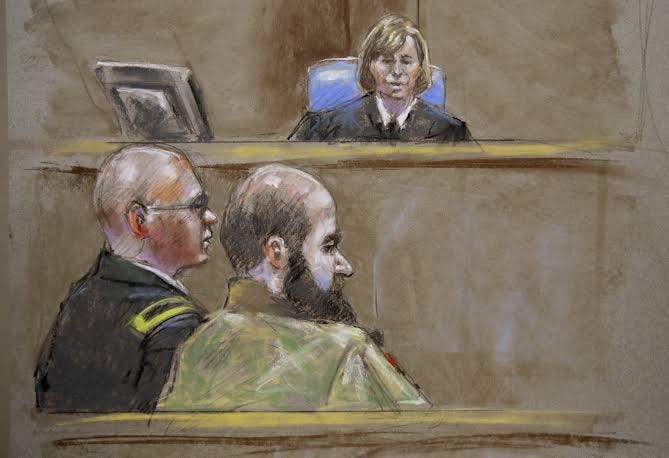
More on all of that below. But first, the (other) news.
On the Docket
The Merits Docket
Last Monday brought with it the Order List out of the Long Conference—which made surprisingly little news. There were no additional grants of certiorari; and only one separate writing (a “statement” by Justice Sotomayor respecting the denial of certiorari in Mulkey v. Alabama). Indeed, besides the first four oral arguments of the term, it was a pretty quiet week on the merits docket all told.
The Emergency Docket
There were three orders by the full Court last week on emergency applications, all of which were denials of stays of execution to Texas death-row prisoner Jamal Howard. Justice Jackson publicly dissented from the second of the three (the one raising Howard’s claim that he was intellectually disabled under Atkins v. Virginia).
The biggest emergency docket news, though, was Chief Justice Roberts’s entry of an administrative stay in FCC v. Brown—the return of the litigation over the FCC’s recent applications of its “Lowest Unit Charge” rule. Especially because right-wing social media is once again misrepresenting what’s actually going on in this case, I thought I’d take a beat to provide some context (apologies in advance for the length):
The basic story here is about an agency that is, quite transparently, trying to run out the clock. Federal law has long been understood—by the FCC itself—to guarantee the cut-rate “lowest unit charge” for pre-election advertising in the last 90 days before an election only to legally qualified candidates, not to political parties or political action committees. On March 30, the FCC’s Media Bureau issued a “Public Notice” purporting to extend that discount to political parties’ coordinated expenditures and to joint fundraising committees with non-candidate members. In April, four Democratic candidates asked the full Commission to set the notice aside, and when the Commission sat on the application (which federal law requires it to decide), they eventually petitioned the Fourth Circuit for review of the agency’s (in)action. On August 25 (18 days after oral argument), a divided panel held that it had jurisdiction—treating the notice as a final legislative rule the Commission had “constructively denied” review of—and set the notice aside on the merits (as exceeding the FCC’s authority), with Judge Wilkinson dissenting.
On September 4, the day the LUC window opened, the Supreme Court, over a lone dissent from Justice Jackson, granted the Trump administration’s request to stay the Fourth Circuit ruling, resting on a likelihood that the panel “lacked statutory jurisdiction” because the relevant statute requires an aggrieved party to wait for the Commission to resolve its application “by order” before seeking judicial review. Critically, nothing in the majority’s 3.5-page opinion said anything about the validity of the FCC’s new interpretation of the LUC rule—or in any way endorsed its procedural gamesmanship. The central flaw the majority identified was simply that the challengers had sought review of agency action that … hadn’t happened yet.
The challengers quickly changed tack. Instead of seeking “review” of agency action not yet taken, they sought an order (a writ of mandamus) from the Fourth Circuit to compel the agency to act (which, again, federal law requires it to do). And on Wednesday, the same panel ordered the FCC to actually decide the pending application by noon on October 9—prompting the Solicitor General to race back to the justices with a new application the next day (the record-breaking 42nd of the second Trump administration), accusing the Fourth Circuit of “a flagrant abuse of the extraordinary writ of mandamus and a baseless effort to circumvent a prior stay entered by this Court.”
As the above description hopefully makes clear, I think that claim is ridiculously overstated. Seeking review of agency action that hasn’t happened is a different beast from asking a court to order an agency to act. And the Fourth Circuit only ordered the FCC to act by a date certain; the court of appeals did not tell the agency how to act. As the Fourth Circuit put it, ordering the Commission to decide “does not evade the prerequisite the Supreme Court identified. It requires the Commission to fulfill it,” while the September 4 stay “remains controlling” for any future merits review. Indeed, one would imagine that, if an executive branch agency were playing these kinds of games to frustrate judicial review during a Democratic administration, the same folks accusing the Fourth Circuit of defiance would agree with the court of appeals’ majority, lest “[a] requirement that the Commission first act becomes a license for the Commission not to act.” It also seems worth adding that, the more the Court writes when it grants emergency relief (as in the September 4 stay), the less lower courts should be over-reading what the Court said.
Anyway, Chief Justice Roberts quickly issued an “administrative” stay of the Fourth Circuit’s ruling (which, again, only would’ve required the FCC to … act on the challengers’ request), and ordered the challengers to respond by 5 p.m. (ET) on Saturday (you don’t see that every day). So it’s possible we’ll get a full Court ruling in what is now captioned FCC v. Brown … anytime. (There’s a parallel application from the National Republican Congressional Committee, but I suspect the Court will just deny that one as moot once it does whatever it’s doing with the FCC’s application.)
The Week Ahead
The Court is closed today for the federal holiday. That probably means we won’t see any movement in the FCC case, but it’s not a guarantee. Otherwise, we’ll have a full day tomorrow, with orders expected at 9:30 a.m. (ET), and oral argument (note the singular) at 10. (For some good hints about possible grants of certiorari we’ll see tomorrow, check out the latest installment of John Elwood’s indispensable “Relist Watch” column.) The Court will hear one more case on Wednesday, and that’ll do it for the (light) October argument session.
Beyond the FCC application, it also seems like a good bet that the Court will rule sometime this week on the Trump administration’s other pending emergency application—in the case about whether federal prisons can deny gender-affirming medical care to transgender prisoners. That application has been fully briefed since Friday.
There are at least two other applications that may produce full Court rulings this week. Wagner v. United States involves a request for release from pretrial detention by a defendant who’s been charged with publishing online statements and social media posts criticizing ICE agents, threatening law enforcement, and discussing potential violence. The district court specifically found that the defendant did not pose a threat, and ordered him released pending trial. But a divided Sixth Circuit panel disagreed, in a ruling that Wagner argues is inconsistent with the law in every other circuit. That application is fully briefed and ripe for a ruling anytime.
Meanwhile, in K.M.K. ex rel. Brown v. Washington State Interscholastic Association, the Alliance Defending Freedom is asking the Court to issue an injunction pending appeal requiring Washington state (which allows transgender girls to participate in interscholastic athletics) to allow cisgender girls to “opt out” of competing against transgender girls. Of course, whether federal law requires states to allow transgender girls to compete in interscholastic athletics (the Court said no in West Virginia v. B.P.J.) is a very different question from whether it bars states from choosing to do so. Anyway, Justice Kagan has ordered a response to the application by 4 p.m. (ET) tomorrow, so this could also move quickly.
The One First “Long Read”:
Devolving Standards of Decency
Before turning to the contours of the Supreme Court’s Eighth Amendment jurisprudence, it might be worth starting with a couple of stage-setting observations. First, I don’t actually expect Hasan to seek to contest in court whatever the government ends up doing with regard to his execution. So far as I am aware, since his direct appeal became final, Hasan has not filed a single collateral attack on his conviction or sentence—either in the military justice system or in the civilian courts. That wouldn’t prevent him from filing one now, but it does suggest that he is uninterested in using the legal system to seek to block his execution. And that leads me to my second point: Before getting to the legality and morality of live-streaming an execution, it’s worth taking a moment to underscore how colossally stupid it would be in this case—where it’s likely only to further Hasan’s homicidal quest for martyrdom.
Third, and speaking of morality, this whole episode reminds me of a judicial opinion I think about a lot—a 2014 dissent from the denial of rehearing en banc by then-Ninth Circuit Chief Judge Alex Kozinski (who stepped down in 2017 after more than a dozen of his former female law clerks and staffers credibly accused him of sexual harassment and abusive employment practices). My issues with its author notwithstanding, I often come back to the opinion’s unusually candid discussion about the decades-old effort to carry out executions by lethal injection, and the massive litigation it has provoked:
The enterprise is flawed. Using drugs meant for individuals with medical needs to carry out executions is a misguided effort to mask the brutality of executions by making them look serene and peaceful—like something any one of us might experience in our final moments. But executions are, in fact, nothing like that. They are brutal, savage events, and nothing the state tries to do can mask that reality. Nor should it. If we as a society want to carry out executions, we should be willing to face the fact that the state is committing a horrendous brutality on our behalf.
Kozinski was even more direct about firing squads:
Sure, firing squads can be messy, but if we are willing to carry out executions, we should not shield ourselves from the reality that we are shedding human blood. If we, as a society, cannot stomach the splatter from an execution carried out by firing squad, then we shouldn’t be carrying out executions at all.
I’ve long had deeply conflicting views about capital punishment. In theory, I’m not completely opposed to it in all cases—at least largely for the reasons why Hannah Arendt was convinced that Adolf Eichmann had to hang. But I have real problems with (1) how often we use it; (2) the well-documented disparities in how we actually use it; (3) the frequency with which the actual executions … don’t go well (most recently in the Christa Pike case); and (4) how impoverished judicial review of our use of it has become—to permit executions in cases in which genuine legal questions about the conviction or sentence remain unanswered. Maybe that’s why I’ve always related, at least a bit, to Kozinski’s suggestion that lethal injection allows society to tell itself a deeply untrue story about the “humanity” of state killing. It’s a lot easier for a society to condone ugly behavior that it’s never forced to confront. (Justice Sotomayor sounded a similar note in her Glossip dissent: “[W]e deserve to know the price of our collective comfort before we blindly allow a State to make condemned inmates pay it in our names.”)
Speaking of society, that’s where the current Court’s significant shift in its Eighth Amendment jurisprudence also shows up. For decades, the Court recognized that, because the language of the Cruel and Unusual Punishments Clause is dynamic, the Clause “must draw its meaning from the evolving standards of decency that mark the progress of a maturing society.” The animating premise, as Trop v. Dulles explained, was that “[t]he basic concept underlying the Eighth Amendment is nothing less than the dignity of man,” so that the state’s power to punish must be “exercised within the limits of civilized standards.”
The Court gave substance to that inquiry most fully in its categorical death-penalty cases, instructing in Atkins v. Virginia that “[t]he clearest and most reliable objective evidence of contemporary values is the legislation enacted by the country’s legislatures,” supplemented by the actual sentencing practices of juries, in order to determine whether a “national consensus” had formed against a given punishment. Critically, Atkins confirmed that this objective evidence does not “wholly determine the controversy,” because “the Constitution contemplates that in the end our own judgment will be brought to bear on the question of the acceptability” of the punishment under the Eighth Amendment. And Roper v. Simmons formalized that two-step method, beginning with “a review of objective indicia of consensus, as expressed in particular by the enactments of legislatures,” and then exercising the Court’s “own independent judgment” on whether the penalty is disproportionate, with attention to the offender’s culpability and the penological justifications of retribution and deterrence.
By the early 2010s, the Court had organized this body of law into two bodies of proportionality precedent—one adopting categorical bans on types of punishment or classes of offenders that were keyed to “mismatches between the culpability of a class of offenders and the severity of a penalty,” and one requiring individualized sentencing—and used the evolving-standards methodology to extend categorical protection beyond capital cases. Throughout this period, this methodology drew sustained dissent—most pointedly from Justice Scalia, who objected that the Court was extracting “national consensus” from small datasets of legislative action and ultimately substituting its own moral views for those of elected legislatures in the states authorizing the challenged punishments—underscoring that “evolving standards of decency,” while settled as the Court’s doctrine, remained contested in application.
Not long after Justice Kennedy retired in July 2018, Scalia’s dissent became the majority view. In Bucklew v. Precythe, for instance, Justice Gorsuch (writing for a 5-4 majority) sharply recentered the Eighth Amendment analysis on the Clause's “original and historical understanding,” displacing evolving standards as the operative mode of decision in the areas it touched. “As originally understood,” Gorsuch argued, “the Eighth Amendment tolerated methods of execution, like hanging, that involved a significant risk of pain, while forbidding as cruel only those methods that intensified the death sentence by ‘superadding’ terror, pain, or disgrace.” On that (putatively) originalist footing, the Court also held that a prisoner must identify a “feasible and readily implemented alternative method” that would significantly reduce a substantial risk of severe pain and that the state has refused to adopt without a legitimate penological reason before he could object to a specific execution method. Bucklew treated this alternative-method requirement as “compelled by our understanding of the Constitution, not by mere policy concerns,” and all but relegated to the dustbin the contemporary-values, dignity-based reasoning that Trop and its progeny had prioritized.
Against that backdrop, it’s not at all obvious that this Court would identify an Eighth Amendment problem with either the military’s use of a firing squad or its public broadcast of an execution. Taking the firing squad piece first, in Wilkerson v. Utah (1879), a unanimous Court upheld a sentence of death by public shooting, holding that “the punishment of shooting as a mode of executing the death penalty for the crime of murder in the first degree is not included in that category” of cruel and unusual punishments. Justice Clifford reasoned directly from military custom, observing that “the usages of the army to the present day are that sentences of the kind may in certain cases be executed by shooting,” and that “[s]oldiers convicted of desertion or other capital military offences are in the great majority of cases sentenced to be shot.” And even outside the military context, the current Court has often pointed to firing squads as potentially better alternatives to some of the more dubious methods states have pursued. It’s hard to see how the firing squad piece of this would thus be the one to raise Eighth Amendment hackles.
The public execution piece is the harder one. In a world in which the “evolving standards of decency” approach were still the dominant one, it would be easy to see the arguments against public executions—especially given all of the reasons why public executions have fallen out of favor. But the Founding-era reality is that executions were ordinarily public events, so under Bucklew’s original-meaning approach, a public execution would not be “unusual” in the sense of a long-disused practice, nor “cruel” unless it were “deliberately designed” to “superadd” terror or disgrace beyond carrying out the death sentence itself. Put another way, the biggest gap between the Court’s “evolving standards” jurisprudence and its current approach involves punishments that were in broad use at the Founding but have since been largely repudiated. And the public execution of Hasan would fall right into that space.
Again, I don’t think that any of this is going to matter. Even if the government goes ahead with a public execution, I don’t expect litigation from Hasan challenging the details, and it’s not clear to me who would otherwise have standing to object. But the public spectacle and moral issues aside, even the idea of public executions provides a useful foil for illustrating the consequences of yet another significant doctrinal shift the Court has undertaken since 2018—one that tends not to be as visible as many of the others.
SCOTUS Trivia: The Denouement in Wood v. Ryan
This isn’t really trivia, but it’s a point that seemed worth adding to the discussion of then-Chief Judge Kozinski’s dissent in Wood v. Ryan. The prisoner, Joseph Rudolph Wood III, was one of six Arizona death-row inmates who sued in an effort to identify (and source) the specific drugs Arizona planned to use in carrying out his lethal injection and the details of how it planned to do so. After the district court refused to issue a preliminary injunction, a divided Ninth Circuit panel issued an injunction blocking further executions in Arizona until the state disclosed (a) the name and provenance of the drugs; and (b) the qualifications of the medical personnel administering them, with the injunction to dissolve automatically once that information was provided.
Instead of providing that information, Arizona sought relief first from the full Ninth Circuit (Kozinski’s dissent is from the full Court’s denial of that request), and then from the Supreme Court. On July 22, 2014, the Supreme Court granted Arizona’s request—over no public dissents. The only explanation the Court provided was that “The district judge did not abuse his discretion in denying Wood’s motion for a preliminary injunction.”
One day later, Arizona executed Wood—but only after badly botching the procedure. According to witnesses, Wood gasped and struggled to breathe for roughly two hours after the drugs were first administered, ultimately receiving 15(!) doses of the lethal-injection drugs even though Arizona’s protocol called for only two, while the execution team also failed to perform required consciousness checks.
To borrow the title of an excellent 2016 Vanderbilt Law Review student note by Alexander Ney, “no clean hands in a dirty business.”
I hope that you’ve enjoyed this installment of “One First.” If you have feedback about today’s issue, or thoughts about future topics, please feel free to e-mail me. And if you liked it, please help spread the word!
If you’re not already a paid subscriber and are interested in receiving regular bonus content (or, at the very least, in supporting the work that goes into this newsletter), please consider becoming one:
This week’s bonus issue for paid subscribers will drop on Thursday. And we’ll be back with our regular content for everyone (no later than) next Monday.
Stay safe out there…
Steve, here's mine, from my substack, re public executions and what will result therefrom.
I can definitely see the ads being sponsored by Amazon. Yep, Jeff Bezos is the one who will glory in “The Show: The Nation’s First Televised, Live-Streamed Public Execution,” and he will get plenty of viewers who will demand more and more of them. Crowds, especially in Europe long ago and in the Deep South much more recently, used to spend some Saturdays watching public executions in huge throngs. People would come for the day, from miles around. You think I'm kidding? There were greeting cards made with photos of the executions; people—execution fans—mailed them to friends & family all over the country, with notes of the events of the day: “Grandma, we had the best time. You shoulda seen that feller twitch! Ooh, it was good. And there was barbecue, beer, and cornbread. Mama said there was refried beans & okra, but I never seed none.”
It was better than Market Day, plus a picnic! Those days might come again, with eating and beer booths, kids jumping and laughing, playing with sticks and marbles, just like the good old days. In some places, I predict there will be hayrides afterward, and lovers will sneak kisses in the corner of the lottery tent. There will be countdowns: 10, 9, 8, 7 …. And door prizes! “Hey, Aunt Sally—you done won a hair dryer! Come on down!” FanDuel & BetMGM will promote betting on which body parts of the prisoner are hit first—and most—and on which shooters—who will, no doubt, be given sporting nicknames—hit which places on the dying/dead man’s body. When a woman is the prisoner/victim/star(?) you can imagine the nature of the bets.
Most likely my own Senator Corn Pone, John Kennedy, will be the announcer, sounding much like Howard Cosell on Monday Night Football, long ago. Or maybe it will be some ambitious MAGA politician; I can see some idiot like Missouri Senator Eric Schmitt, who made such a fool of himself last week in his public interrogation of Jack Smith, or Lauren Boebert, who would—no doubt—do a bang-up job of announcing!
Yep, the Secretary of Death, Whiskey Pete, has created something for his legacy, something that may outlive the story of his total incapacity as Secretary of Defense. Televised public executions may well become a Rorschach test between "the woke" and “Real ‘Mericans.” Amazon Prime will pay to have exclusive rights to all US public executions—no doubt will bid for more public executions worldwide and will pay enormous sums to North Korea, Iran, China, and Afghanistan, helping to support those horrible, bloodthirsty regimes— and whenever there is the least glimmer of a hint or rumor from Amazon that it might stop these telecasts there will be enormous uprisings from Trumpist media, threatening that millions of consumers will boycott Amazon (and create nasty, belittling messages about Bezos and his wife). David Brooks will write a column asserting “Liberals … something, something … Obama … concern … phony … fad … drift … something something … Mamdani … trans people.” Susan Collins will claim that she authored it, and Brooks stole it.
Our standards of decency as a society have been so degraded that it is impossible to imagine what we would not tolerate.