

Welcome back to “One First,” a newsletter that aims to make the U.S. Supreme Court more accessible to lawyers and non-lawyers alike. I’m grateful to all of you for your continued support, and I hope that you’ll consider sharing some of what we’re doing with your networks.
If you’re not already a subscriber, please consider becoming one—and upgrading to a paid subscription if and when your circumstances permit:
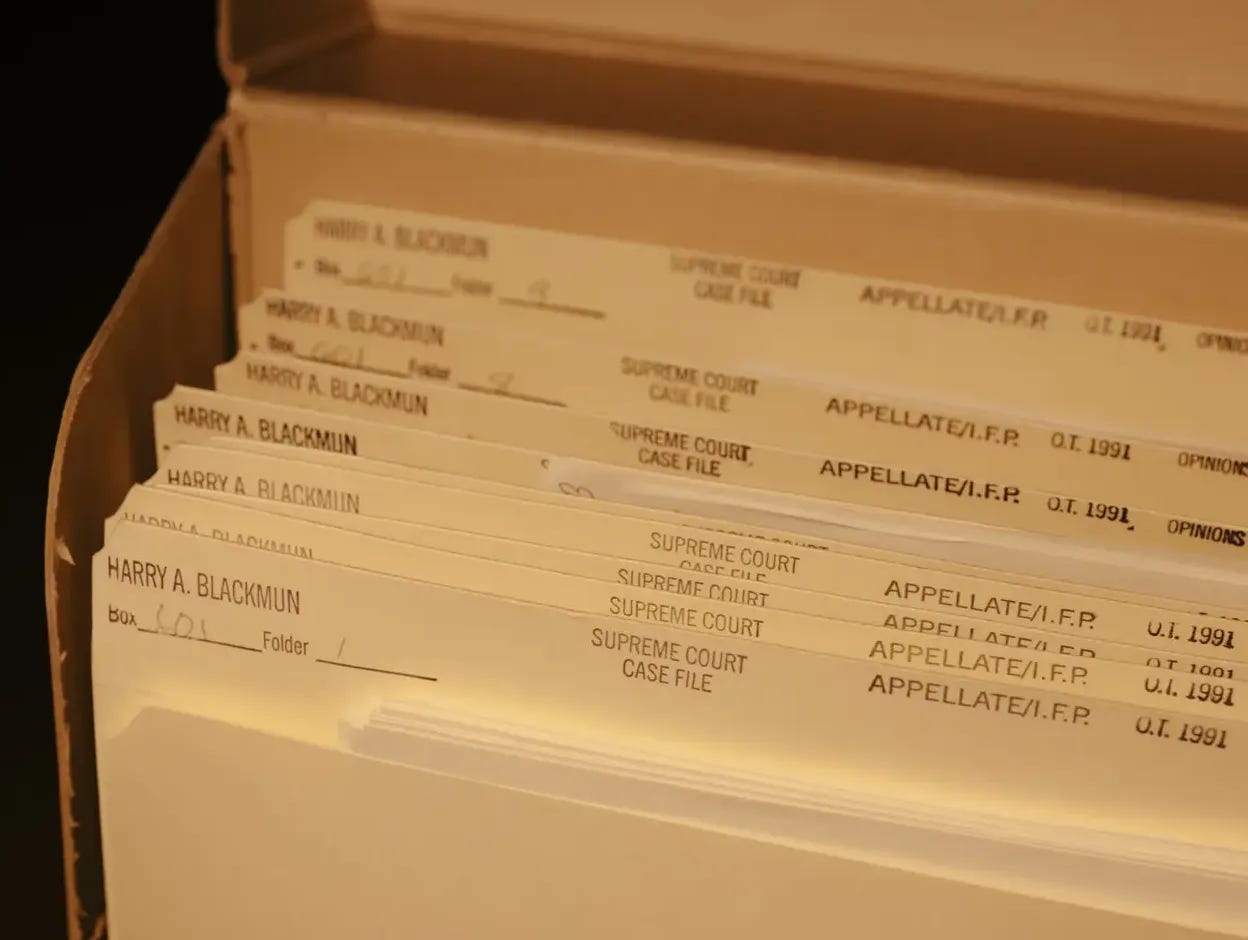
I had been waiting until things calmed down (ha!) to devote a post to the scattershot rules governing the release of the justices’ internal papers (especially their case files); how that topic dovetails with broader concerns about the Court’s lack of transparency; and the broader point that, whatever the right answer is, Congress ought to create uniform rules for when and how the justices’ papers become accessible to the public—just like it has for presidential records. Then, on Tuesday, Jodi Kantor published a remarkable story for the New York Times on the same topic, with lots of new reporting on the internal scramble after Justice Scalia’s (unexpected) February 2016 death to figure out when and how his papers would become available for public scrutiny (TL;DR: it’s complicated, but for case files, it’s when the last justice with whom he sat that term dies—so probably at least another 30 years from now for all of them).
After recapping a very busy week of Supreme Court news (especially for the first week of September), today’s post tackles that topic—offering a brief summary of what we know about the papers that are currently unavailable; where folks can find those papers that are accessible (including just how awesome and helpful the folks at the Library of Congress’s Manuscript Division are); and why, whatever the right answer is to the question of when justices’ papers are made public going forward, it ought to be a uniform rule that comes from Congress—and not something that gets left up to the whims of individual justices, or, as in Scalia’s case, their estates. My thanks, especially, to Ava Singh (Georgetown Law ’27), for meticulous assistance in researching this topic.
But first, the (current Court’s) news.
On the Docket
Last week kicked off with Monday afternoon’s 5-4 ruling granting a stay pending appeal in the White House ballroom case, with Chief Justice Roberts writing for himself and the three Democratic appointees in dissent. I had lots to say in Thursday’s bonus post about that deeply misbegotten ruling, and won’t rehash those points here. All I’ll flag for now, because it’s going to be relevant in a minute, is that it was the third straight grant of emergency relief that the Court accompanied with a full (if unsigned) “opinion of the Court.”
Friday morning brought with it the last of the regular summer Order Lists—a series of housekeeping matters, none of which were especially newsworthy. The Court also released on Friday the argument calendar for the “December” 2026 sitting (which starts on November 30). That sitting includes the AR-15 cases on December 2; the transgender parental rights/medical care dispute on December 7; and an important dispute about whether federal law bars states from forcing putative voter registrants to produce documentary proof of citizenship on December 8. But it also includes four open slots across six days—yet more evidence that the upcoming term will once again be back-loaded with big cases (because the justices aren’t filling out the docket in the earlier sessions).
And right before the long weekend, we received the second full Court grant of emergency relief of the week—with the justices blocking a lower court ruling that had frozen an FCC proposal to apply to political parties the requirement that TV stations impose only the “lowest unit charge” on ads by political candidates as Election Day approaches. (In other words, the Supreme Court’s intervention will make ad buys for political parties, especially Republicans, cheaper, at least until November.) It’s not an especially high-stakes case (which may explain why only Justice Jackson publicly dissented), but that ought to have been reason enough for the Court to deny the stay. Instead, after getting the jurisdictional question wrong (per Justice Jackson’s dissent), the Court appears to have made yet more new law on what counts as “irreparable harm,” explaining that having to spend more money to reach voters with election-season ads irreparably harms the applicants by “hampering their efforts to reach the electorate in the critical weeks leading up to the midterms.” The Court has, historically, been adamant that monetary harms are seldom irreparable since having to spend extra money to achieve the same goal can usually be recouped after the fact. Alas.
One last note about Friday’s ruling in National Republican Congressional Committee v. Brown: The Court once again produced an (unsigned) majority opinion—the fourth straight grant of emergency relief to be accompanied by an opinion of the Court. (You have to go back to May 14 to find grants without majority opinions.) I wondered in Thursday’s post about whether the justices have adopted a new norm of always writing an opinion of the Court when they vote to grant emergency relief; four in a row is even stronger evidence that this may be a thing than the three I was relying upon then. And as I suggested on Thursday, that’s both a positive development (the content of the writing notwithstanding), and one that would necessarily reflect a Court once again showing itself to be reactive to public criticism—at least when that criticism is framed in institutional (as opposed to political or ideological) terms.
The emergency docket is also likely to figure prominently during the week to come, thanks to two major, pending emergency applications. The first is in the mail-in ballots case. On Thursday, the Trump administration filed an application seeking a stay of Judge Talwani’s TRO (#37, if you’re keeping count), once again seeking to put back into effect its effort to restrict which mail-in ballots will be delivered by the U.S. Postal Service. But that application was mooted by the preliminary injunction Talwani entered on Friday. So yesterday, the administration withdrew the first application and filed a new one (#38)—this time seeking a stay of the preliminary injunction itself and an immediate administrative stay. As with the previous application, Justice Jackson (as Circuit Justice for the First Circuit) did not issue an administrative stay, but did set a tight deadline for a response—the plaintiffs’ briefs are now due Wednesday at 4 p.m. ET. Thus, it’s at least possible that the Court will rule on this latest application (U.S. Postal Service v. California) by the end of this week—and next week at the latest. The First Circuit is also moving quickly, so it’s also possible (if not likely) that it will rule first, although I think everyone expects it to deny the stay.
And late Friday (although it was docketed on Saturday), Missouri filed an emergency application asking the justices to pause the Missouri Supreme Court’s unanimous ruling that had blocked, on state-law grounds, Missouri’s 2026 gerrymander, which had been designed to create an additional safe Republican seat in the Show-Me State’s eight-member House delegation. (In other words, Missouri is asking the justices to restore the 7R-1D map.) Missouri’s pretty hysterical application (it opens “A federal-election-administration disaster is unfolding in Missouri.”) fails to mention some pretty important facts, including that there are prior examples of states conducting general elections with different districts than the ones that had been in place for the primaries. Its central claim is that the state supreme court’s decision, by requiring this result, violates the federal Constitution—a not-so-subtle effort to invoke the “Independent State Legislature” theory that the Court declined to embrace (or, alas, conclusively reject) in Moore v. Harper. Justice Kavanaugh ordered the challengers to respond by noon today (even though it’s a federal holiday), so this one is likely to move quickly, too.
When the Court rose for its summer recess back in June, I suggested that it was too soon to close the book on OT2025 because we were likely to see a flurry of important emergency applications before the term “officially” ends on the first Monday in October. After a quiet beginning to the summer, things sure are picking up…
The One First “Long Read”:
How the Sausage Gets Made Public
The justices’ papers have long been a subject of intense academic study and controversy. There is a lot to learn about the Court’s internal machinations and deliberations from the justices’ internal records of the proceedings, and forests have been felled about the lessons that can be divined not just with respect to the decisionmaking processes in individual cases (like the initial vote at Conference in Casey to overturn Roe) but the justices’ personal relationships and procedural behavior more generally. If anything, given how much of the Court’s real-time output is shrouded in secrecy (everything from the votes for certiorari to who had, and then lost, an original opinion assignment after oral argument), the internal papers have become even more important to try to piece together how the Court got from A to B.
There’s also a related body of meta-scholarship about the debate over when and how the justices’ papers should become accessible. Professor Susan David deMaine, who’s the Director of the Law Library at the Maurer School of Law at Indiana University, has written extensively on just about all of this—my favorites are her 2018 Law Library Journal article, “Access to the Justices’ Papers: A Better Balance,” and a 2022 co-authored empirical study of how scholars have used the papers of Justices Brennan, Marshall, and Blackmun. (There’s also a great 2013 NYU Law Review article by University of Washington professor Kathryn Watts, “Judges and Their Papers.”) And there have been a series of historical flashpoints, including Justice Marshall’s decision to make his papers available immediately upon his 1993 death—a move that provoked a remarkably sharp and negative response from Chief Justice Rehnquist on behalf of “a majority” of the Court.
Here’s what we know about what we don’t currently know:
I. Nine Former/Retired Justices With Existing Restrictions
Counting Justices Kennedy and Breyer (who, so far as I know, have yet to make any public announcement about what’s going to happen to their papers), there are nine former justices whose case files, in particular, are not yet (fully) accessible to the public. For the seven whose plans have been announced, here are the details (in chronological order based on when they left the Court—which I’ve indicated in parentheses):
Warren Burger (1986): Despite some sources suggesting that Burger’s papers were due to become available later this month (40 years after his retirement), it appears that his papers will in fact become available on December 1, 2033—ten years after the death of Justice O’Connor, the last surviving justice with whom Burger served. Burger’s papers were donated to William & Mary.
William H. Rehnquist (2005): Rehnquist donated his papers to the Hoover Institution at Stanford University, and the papers are being opened on a rolling basis with portions of the papers being opened following the deaths of each of his former colleagues. Currently, papers from OT1987—OT2005 remain closed, presumably because Justice Kennedy was nominated to the Court in 1987 and is still alive. If that approach holds, Rehnquist’s papers will not be fully available until after Justices Kennedy, Thomas, and Breyer have died.
Sandra Day O’Connor (2006): O’Connor gave her papers to the Library of Congress. Papers through OT1990 are available to the public (and have provided a bit of a treasure trove already). But she restricted access to the papers from OT1991—OT2005 until all justices who served with her have retired. Justice Thomas’s retirement would open most of that period up (OT1991—OT2004), leaving only OT2005 for when Chief Justice Roberts retires.
David Souter (2009): Souter’s papers were donated to the New Hampshire Historical Society and are closed until 50 years after his death—so they won’t become available until May 8, 2075. Sigh.
John Paul Stevens (2010): Stevens donated his papers to the Library of Congress starting in 2005, while he was still on the Court. The first installment of papers from OT1975—OT1984 opened in 2020, and the second installment of papers from OT1985—OT2004 opened in 2023. The papers from OT2005—OT2010 will remain closed until October 2030 per Stevens’s instructions. (Importantly, because of the others’ restrictions, Stevens’s papers are the only ones currently open with coverage of OT1994 or any later term, up to and through OT2004.)
Antonin Scalia (2016): Scalia’s papers are held at the Harvard Law Library and there are a number of restrictions on them based upon the type of file. The “correspondence” files will be opened on a rolling basis with the files from 2016 being released in 2047, which is 30 years from the date of creation. The “speaking engagement and event” files will similarly open on a rolling basis, with files becoming available 30 years after the date they were created. Papers from Scalia’s time on the D.C. Circuit also open periodically following the death of judges who participated in individual cases. All D.C. Circuit case files are expected to be open by 2050—but individual items within the case files may be closed longer. The papers from his time on the Supreme Court will open for a particular term upon the death of all other justices who served during that term (the youngest justice to have served with Scalia is Justice Kagan).
Ruth Bader Ginsburg (2020): Ginsburg donated her papers to the Library of Congress. The papers include both personal papers (such as birthday cards and well wishes) and papers relating to her career and time on the Court. Certain papers are available now; another batch will become available on January 26, 2027; and others will become available 25 or 50 years after her death (September 18, 2045 and September 18, 2070), respectively. As for the case files, specifically, those files will remain closed until all judges or justices who participated in that case have died. Because Justices Thomas and Breyer are still alive, that means none of her case files from the Supreme Court are open yet. Certain papers also involve sealed files which must remain restricted until the Court unseals them.
II. Where to Find Everything Else
Professor deMaine’s 2018 article has an incredibly useful appendix that identifies the donations and access restrictions on the most significant collections of papers for every justice to serve on the Court during and since 1900. Although the collections are (literally) all over the place, the most common location is the Library of Congress—where the papers can be accessed through the Manuscript Division.
That gives me an excuse to note that I wrote a lengthy article early in my career that attempted to reconstruct (and then deconstruct) the Supreme Court’s cryptic but important 1948 decision in Hirota v. MacArthur (rejecting a last-ditch effort to get the justices to review the Tokyo war crimes tribunal on the ground that it was really an American operation, and thus subject to American judicial review), a project that relied heavily on access to the justices’ papers from the October 1948 Term. It turns out that the mystery could largely be untangled from the internal papers of Justices Black, Jackson, and Rutledge, specifically—including a draft opinion by Rutledge that my article was the first to make public. There’s just so much more context one can glean from seeing how the justices processed things internally than is often visible from what is ultimately produced for public consumption. (Even Chief Justice Roberts invoked Justice Blackmun’s papers during the oral argument in Dobbs.)
Let me also note here how amazingly helpful the folks at the Manuscript Division were (and continue to be). One need not be an accredited law professor writing an article to access these papers; it’s open to “readers age 16 and above who have a specific need for access to the collections of the Manuscript Division and associated materials.” More details are available here.
III. The Case for Uniformity
I’ve saved the most controversial part for last, but as the haphazardness described above should drive home, it sure would be useful if there were a uniform set of rules to govern how/when the justices’ papers become public. In her 2018 article, Professor deMaine identified the source of the problem as the fact “that the Supreme Court Justices continue to have personal ownership of their working papers, resulting in idiosyncratic retention and access decisions.” (For what it’s worth, the justices have asserted personal ownership of their papers, but there’s no external authority agreeing with them, and it seems odd to think that the government owns every other piece of paper produced by government employees on the job except the ones produced by the justices in their chambers.)
Regardless, Congress, deMaine argued, should assert (or, in my view, re-assert) ownership over the justices’ papers—and create a uniform moving wall for when case files, at the very least, would be released to the public—sometime between ten and twenty years after a justice retired, regardless of who is still serving on the Court. As she suggested,
A window of no fewer than ten years and no more than twenty would allow the Justices, and others represented in the collections, a long stretch of confidentiality and would ensure that no matters discussed in the papers were still in front of the Court. After twenty years, access restrictions would be allowed only on materials the discourse of which would “constitute an unwarranted invasion of privacy.”
As deMaine’s article explains, such a proposal largely tracks a series of recommendations made by the 1977 National Study Commission on Records and Documents of Federal Officials. If that were the rule today, we’d already have access to Rehnquist’s, O’Connor’s, Souter’s, and Stevens’s papers in full (bringing us to the end of OT2009); with Scalia’s (middle of OT2015) and Ginsburg’s (end of OT2019) papers not far behind—versus decades away from public view.
But whatever the “right” answer is, it shouldn’t be controversial to suggest that public awareness of the Court is not well-served by a series of widely varying access rules crafted by the justices (or their estates) to serve the justices’ purposes, rather than the public’s. Judicial deliberations can and should be confidential—for a time. But we already know so much more about the Court because of what we’ve learned from the justices’ internal papers from earlier generations. Having a uniform and predictable set of legislatively imposed rules to govern the release of papers going forward would not only help to increase the Court’s transparency, but it would also reaffirm that the justices’ work, which increasingly affects all of us, also belongs to all of us.
SCOTUS Trivia: Who’s Number Two?
The Library of Congress remains the repository of choice for the justices’ papers. By my count, it holds the “principal” collections of 38 justices’ papers. There’s no official claim to second place, but I’m pretty sure it belongs to the Harvard Law School Library—which houses the principal collections of five justices: Joseph Story, Oliver Wendell Holmes, Jr., Louis D. Brandeis, Felix Frankfurter, and, most recently, Antonin Scalia. Of course, given that Harvard Law graduated twice as many justices as any other law school (18, to Yale’s nine), this particular piece of trivia may not be all that surprising.
I hope that you’ve enjoyed this installment of “One First.” If you have feedback about today’s issue, or thoughts about future topics, please feel free to email me. And if you liked it, please help spread the word!
If you’re not already a paid subscriber and are interested in receiving regular bonus content (or, at the very least, in supporting the work that goes into this newsletter), please consider becoming one:
This week’s bonus issue will drop on Thursday. As ever, I hope you are all staying safe out there, especially from whatever is in the justices’ internal papers.
If the justices were less secretive about their deliberations, would there be fewer leaks and less speculation?
A theoretical question, perhaps...but a desire for secrecy and an almost godlike sense of self-importance do seem to be throughlines that help explain much of their public behavior.
I find it impossible to view all this secrecy as anything other than protecting what oughtn't to be tolerated in any free society. The former justices seem most concerned with protecting their colleagues, under some sort of euphemism about the Court's "dignity." I have not read any of these so-called personal papers, but the numerous recent decisions I have read put paid to any such "dignity" as the Court might have tried to assert.