

Welcome back to “One First,” a newsletter that aims to make the U.S. Supreme Court more accessible to lawyers and non-lawyers alike. I’m grateful to all of you for your continued support, and I hope that you’ll consider sharing some of what we’re doing with your networks.
If you’re not already a subscriber, please consider becoming one—and upgrading to a paid subscription if and when your circumstances permit:
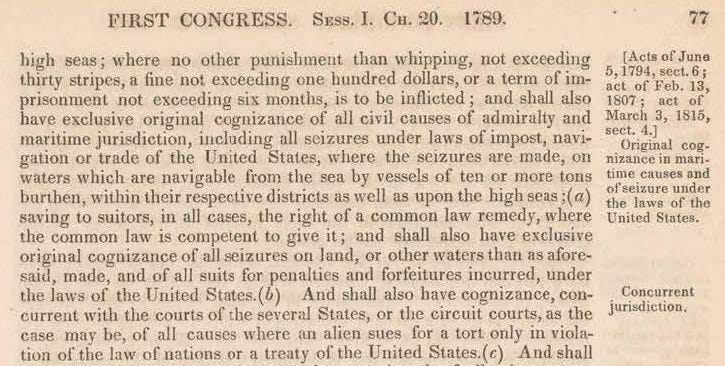
One of the quieter casualties of the Court’s just-completed term is the modern descendant of a 1789 statute that, for nearly half a century, was used to allow victims of torture and other grave human rights abuses to walk into a federal courthouse and ask for a remedy. In Cisco Systems, Inc. v. Doe I, a majority comprising all six Republican appointees effectively shut that door—and, as I’ll explain, it did so by overruling a unanimous 2004 precedent without ever fully acknowledging that that’s what it was doing, and through reasoning that says a lot more about this Court’s (lack of) regard for its own past decisions than it does about the relevant clause of section 9 of the Judiciary Act of 1789—known today as the Alien Tort Statute (“ATS”).
To that end, today’s “Long Read” traces how the ATS went from a “legal Lohengrin” to a human rights workhorse and back again; why Justice Barrett’s account of the statute in Cisco doesn’t hold together; and why one case the majority conspicuously ignored—the Abu Ghraib litigation out of the Fourth Circuit—shows just how much we all stand to lose when the Supreme Court closes the courthouse doors to these kinds of lawsuits.
More on that below. But first, the news.
On the Docket
The Supreme Court issued the first of its regular summer order lists last Monday—adding one case to the merits docket for the upcoming term, and denying a number of rehearing petitions (and re-filed applications). Those were the only full Court rulings to come down last week. Speaking of rehearing, although President Trump has publicly committed to seeking rehearing of the Supreme Court’s June 30 decision in the birthright citizenship case, the deadline for filing such a petition is today (technically, it was Saturday, but that bumps it to today). It’s President Trump, so you never know. But I’m not holding my breath.
The One First “Long Read”: The ATS, Then and Now
There are exactly 33 words in the Alien Tort Statute (as amended), and for most of the two centuries after Congress enacted it as part of the Judiciary Act of 1789, they received little attention. The statute gives the district courts “original jurisdiction of any civil action by an alien for a tort only, committed in violation of the law of nations or a treaty of the United States.” That was it. It doesn’t expressly provide a cause of action; it doesn’t list specific, covered wrongs; and there is next to no legislative history to help illuminate why Congress included it in the federal judiciary’s founding charter. Nor did history help; for nearly 200 years, the statute mostly sat on the shelf. Courts invoked it a handful of times, but nobody was quite sure what it was supposed to do.
The modern history of the statute starts with Filártiga v. Peña-Irala, in which a Paraguayan family found their son’s torturer living in Brooklyn and sued him under the ATS for his 1976 killing back home. In 1980, the Second Circuit held that the statute reached the claim—that deliberate torture by a state official violated the law of nations, and that federal courts were open “for adjudication of the rights already recognized by international law.” The court read the ATS not as manufacturing new rights but as providing a domestic forum for a wrong the world had already condemned, and it grounded that reading partly in foreign relations, reasoning that claims “fraught with implications for the nation as a whole” belonged in federal court rather than being left to fifty different state courts.
Filártiga set off a wave of human rights litigation—including significant rulings from at least three different federal courts of appeals (the Second, Ninth, and D.C. Circuits) in the 1980s and 1990s. It also led to an enormous and sustained debate among academics—who fought bitterly over the extent to which U.S. courts could (and should) provide remedies for violations of “customary international law,” i.e., international legal principles and norms that were not part of statutes or ratified treaties, and thus were not (at least obviously) the law of the land for purposes of the Constitution’s Supremacy Clause.
Even as that debate raged on, the Supreme Court didn’t weigh in for almost a quarter of a century. And when it finally did, in Sosa v. Alvarez-Machain, it landed on a compromise that would govern ATS litigation for the next two decades. Justice Souter, writing for the Court, agreed that the ATS is “strictly jurisdictional” and creates no causes of action on its own—but rejected the argument that this made the statute “stillborn.” The First Congress, the Court reasoned, understood that courts would recognize a modest set of common-law claims for violations of international law as well defined and universally accepted as the paradigms the drafters had in mind in 1789 (offenses against ambassadors, violations of safe conduct, and piracy—what the Court now calls the “Blackstone three”).
Going forward, Sosa held, courts could recognize new claims, but only for norms of comparable “definite content and acceptance among civilized nations,” and only with great caution. That was Sosa’s famous second step: narrowing the scope of ATS claims relative to the most extreme lower-court rulings, but leaving federal courthouse doors unmistakably open. Justice Scalia wanted those doors shut altogether, but he didn’t get five votes (or even four). Only Chief Justice Rehnquist and Justice Thomas took the narrowest view of the ATS in 2004.
The Court spent the next two decades narrowing that opening, but it kept declining to overrule Sosa itself. In its 2013 ruling in Kiobel v. Royal Dutch Petroleum, the Court initially granted certiorari to decide whether corporations could be proper defendants under the ATS, but then held, on re-argument, that the ATS wasn’t available in “foreign-cubed” cases—those in which foreign plaintiffs sued foreign defendants for conduct on foreign soil. Only if the claims “touch and concern” U.S. territory “with sufficient force to displace the presumption” against extraterritoriality would Sosa’s framework be available.
Then, in its 2021 decision in Nestlé USA, Inc. v. Doe, the Court held that “general corporate activity”—operational decisions made in U.S. boardrooms—was not enough domestic conduct to let former child laborers sue two American companies over forced labor on Ivorian cocoa farms. That was enough to decide the case, and tellingly, Justice Thomas’s effort to go further and hold that Sosa should be scrapped entirely, couldn’t hold a majority; Chief Justice Roberts and Justice Barrett pointedly declined to join it, with Justice Sotomayor noting separately that such an approach “would overrule Sosa ‘in all but name.’”
Then, on June 23, and without any attempt to reconcile their prior adherence to Sosa, the Chief Justice joined Justice Barrett’s opinion for a six-justice majority in all but relegating Sosa to the scrap heap. In Cisco, plaintiffs alleged that Cisco and two of its executives had helped the Chinese government build the “Golden Shield” surveillance system used to identify, detain, and torture Falun Gong practitioners, and they sued under both the ATS and the Torture Victim Protection Act. Justice Barrett, writing for herself, the Chief Justice, and Justices Thomas, Alito, Gorsuch, and Kavanaugh, held that federal courts “may not create new causes of action” under the ATS at all—including for aiding and abetting—and that the TVPA likewise does not reach those who aid and abet torture. The three Democratic appointees all dissented from the ATS holding, and Justice Sotomayor dissented from the TVPA holding.
Formally, Cisco doesn’t eviscerate the ATS. But it takes a huge bite out of it (and Sosa), by eliminating the power of courts to recognize new international-law claims that were not available in 1789. What’s left is what Scalia wanted in his Sosa concurrence and what Thomas pressed for in Nestlé: the ATS as a jurisdictional grant and nothing more, good for the three offenses Blackstone catalogued in 1789 and, well, that’s it. Justice Sotomayor called this what it is—a “sub silentio overruling of Sosa” that “marks yet another low point in this Court’s esteem for its precedents”—and she’s right. The whole significance of the compromise in Sosa was the Court leaving the door open for ATS suits for offenses other than the “Blackstone three.” By cabining the ATS to those three offenses and nothing more, Cisco renders Sosa a dead letter.
In many respects, reading the opinions in Cisco is like re-reading the opinions in Sosa. It’s the same debate about the relevance of the same sources and arguments to the interpretation of the same statute. And that’s what really bothers me: the majority never really explains why Sosa had to go. Sosa was unanimous on the point that courts retain some power to recognize international-law claims. It was 20 years old. Litigants, human rights advocates, and lower courts had built two decades of doctrine on top of it. Under any of the versions of stare decisis the current justices have professed to follow, that combination usually counts for something.
The Cisco majority engages with almost none of that. Its two stated reasons—that Sosa’s second step was “narrow at the outset,” and that judicially implied causes of action are disfavored today—are arguments about why Sosa was wrong (again, just read Scalia’s Sosa concurrence), not reasons why a wrong-but-entrenched precedent must now be abandoned. Those are different questions, and the Court has spent years insisting they are different questions. “We now think the 2004 Court got it wrong” is not a special justification; it is just disagreement, and disagreement with a prior Court has never been enough, by itself, to justify tossing out its ruling. Beyond its implications for human rights litigation in the United States (about which more in a moment), this is the most alarming part of Cisco: stare decisis really is, as the hosts of Strict Scrutiny so often put it, for suckers.
The other major move in Cisco is Justice Barrett’s suggestion that recognizing ATS claims carries an inherent risk to American foreign relations—that letting these suits proceed invites the courts to meddle in matters the Constitution assigns to the political branches. Especially given how Kiobel and Nestlé had already narrowed the ATS to minimize its impact in cases with foreign implications, that move seems underdefended at best—all the more so in light of a high-profile case that the Court didn’t even discuss: Al Shimari v. CACI Premier Technology.
Al Shimari is the Abu Ghraib case. Four Iraqi men, arrested and detained by the U.S. military in 2003 and later released without charge, alleged that interrogators working for CACI—a Virginia-based government contractor—conspired with soldiers to torture them. After 16 years and five trips to the Fourth Circuit, the case was pared down to two ATS claims, and in 2024 a jury found CACI liable for conspiracy to commit torture and cruel, inhuman, and degrading treatment, awarding the three remaining plaintiffs a total of $42 million. On March 12, 2026—three months before Cisco—the Fourth Circuit affirmed. And it directly confronted the foreign-relations worry that animates Barrett’s opinion. Because Congress had itself endorsed torture claims under the ATS and its companion statutes, the court explained, “allowing this case to proceed lacks any potential to negatively affect foreign relations.” If anything, the court said, the opposite is true: “nothing would be more offensive to the arena of foreign relations than to proclaim that courts of the United States may not provide a remedy to foreign nationals who were tortured by members of the U.S. military.”
The existence of cases like Al-Shimari (and Al-Shimari itself) is, to me, the critical point Justice Barrett’s opinion elides. The foreign-relations objection has at least some force in “foreign-cubed” suits like Kiobel, where U.S. courts are asked to referee a dispute among foreigners over conduct abroad. It has almost no force where the defendant is an American company and the alleged wrong is torture carried out under color of U.S. authority in a manner that, per Kiobel, “touches and concerns” U.S. territory. In those cases, refusing to hear the claim doesn’t protect American diplomacy—it announces to the world that the United States offers no forum when its own contractors and companies are accused of grave human rights abuses. Al Shimari shows how this is supposed to work. There, you had an ATS suit that went to a jury after years of litigation over jurisdictional and procedural predicates. The case not only produced a verdict, but it survived every foreign-relations and separation-of-powers objection that CACI raised. In other words, Al-Shimari illustatres the very accountability that the ATS was revived to provide, delivered without any of the diplomatic ramifications that Justice Barrett’s majority opinion just assumed are inevitable.
Whether Al Shimari itself survives is now an open question—CACI is already arguing that Cisco forecloses the plaintiffs’ aiding-and-abetting theory, and the plaintiffs are countering that torture, like piracy, sits within even the narrowest reading of the 1789 statute. (Perhaps needless to say, I’m deeply sympathetic to the plaintiffs here.) But however that case comes out, its stakes will be deeply significant. For 46 years, the ATS gave torture survivors somewhere to go when no one else would hold their abusers to account—all the more so when the abusers were Americans or American corporations. Cisco has taken most—if not all—of that away. The problem isn’t just what Cisco means for human rights plaintiffs, real as that is. It’s how little work this Court now thinks it has to do before walking away from a precedent it no longer likes—something that the same 6-3 majority would do two more times in the seven days between Cisco and the last hand-downs of the October 2025 Term.
SCOTUS Trivia: The Fifth Seal
For … reasons, I was recently watching a (bad) old West Wing episode (from the sixth season, by which point everything had gone to pot), where Vice President Bob Russell keeps telling his completely unfunny joke about how, if he looks at the Vice President’s seal just so, it kinda looks like it says “President of the United States.”
Somehow, that got me thinking about the Supreme Court’s seal—including its history and evolution. Here’s an image of the current version:
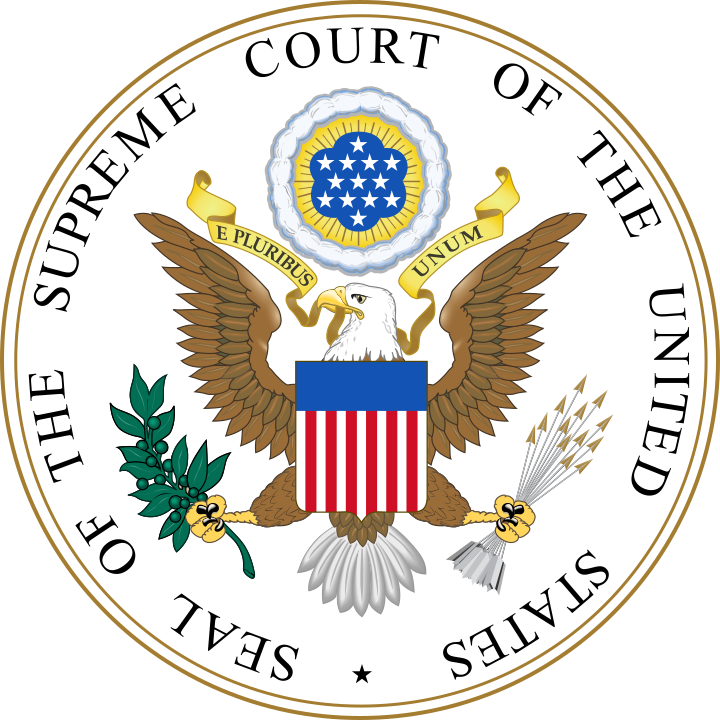
As it turns out, the current seal is the Court’s fifth in its history. On Wednesday, February 3, 1790—during the very first sitting of the Supreme Court—the Court ordered “that the Seal of this Court shall be the Arms of the United States, engraved on a circular piece of Steel of the Size of a Dollar, with these words in the Margin ‘The Seal of the Supreme Court of the United States.’” That original die served the Court for four decades; its last known use came in August 1831, on the papers in Worcester v. Georgia.
Four successive redesigns followed, culminating in the larger, less ornate version the Court ordered in May 1904 and adopted on May 4, 1905—the one still in use today. The symbolism is derived from the Great Seal of the United States, as are most of the design elements. Indeed, besides the Court’s name, the only detail that’s specific to the Court’s seal is also the one with the most meaning: beneath the eagle’s claws sits a single star, representing the “one supreme Court” that Article III creates—a not-so-subtle reminder that the Constitution mandates exactly one such body and leaves control over the existence, size, and scope of the rest of the federal judiciary to Congress.
The seal remains in the custody of the Clerk of the Court, who stamps it on official papers—including the admission certificates issued to new members of the Supreme Court bar and, as I’ve learned the hard way, the official judgment handed down 32 days after a merits case has been decided.
I hope that you’ve enjoyed this installment of “One First.” If you have feedback about today’s issue, or thoughts about future topics, please feel free to email me. And if you liked it, please help spread the word!
If you’re not already a paid subscriber and are interested in receiving regular bonus content (or, at the very least, in supporting the work that goes into this newsletter), please consider becoming one:
This week’s bonus issue will drop on Thursday. As ever, I hope you are all staying safe out there—especially from human rights abuses, for which there are increasingly few remedies in U.S. courts.
Your lament for stare decisis points at the core problem with the Roberts "court": it contains a solid majority of "justices" who, whatever they may otherwise profess, do not believe in the rule of law or the Constitution they swore an oath to uphold. Judges who appropriately respect stare decisis demonstrate that they respect the law even when they disagree with it. This "court" displays no such respect. If it disagrees with the Constitution, it invents fundamental alterations in that document (presidential immunity). It continuously exalts its own power at the expense other elements of the federal judiciary, disregarding procedure, inventing facts and standing in order to arrive at desired results, displacing the "lower" courts' role as fact-finders. This is just what leaps to mind: regular readers of One First might make a lengthy list of such defalcations, usurpations, dishonesty, and lawlessness. We do not have a functioning Supreme Court - not, that is, a Supreme Court that behaves like a real court - and we haven't had one for quite some time. We just have people in black robes who aren't actually Justices but play them on TV. Justice Kagan (one of the three to whom the title may be applied without scare quotes) may be right when she denies that the "Court" majority has a strictly partisan agenda. The real situation may be worse. The majority's agenda is, in essence, authoritarian, that is, the pursuit and exercise of power for its own sake, without regard to law, in service of the majority's personal policy preferences. True, that aligns quite often with MAGA desires, but only because, as the saying goes, birds of a feather flock together.
In response to Joe, it is correct that "manufacturing of a broad legal right" is judicial overreach. But interpreting a statutory clause such as a grant of jurisdiction to cover matters closely analogous to those nonexclusively and somewhat vaguely described in the statute - that's not overreach, it's what we have a Supreme Court for. Jettisoning such a precedent without thorough examination of why it was so incorrect as to require such a drastic action amounts to no more than a statement of personal preference, not legal reasoning.
I spent the first decade of my career working on Section 1350 cases. I was on the Alvarez Machain and Doe v Unocal teams, and worked closely with Paul Hoffman (who argued Cisco).
Few things depress me more about the current Supreme Court than what they did to Section 1350. A bunch of conservatives hated a statute but lacked the votes to repeal it, so they just killed it with a thousand cuts judicially. Not only is stare decisis for suckers-- textualism and plain meaning is as well.
And the same people who claim "subject to the jurisdiction" creates an open canon for new grounds to deny citizenship, think "tort in violation of the law of nations" is a closed canon limited to 3 torts described in Blackstone's English law treatise.
Just sad all around.